Why Japanese and German Knives Feel So Different
One feels like a scalpel, the other like a trusty tool you could drop on the floor. The difference comes down to steel, angles and how each tradition likes to cut.
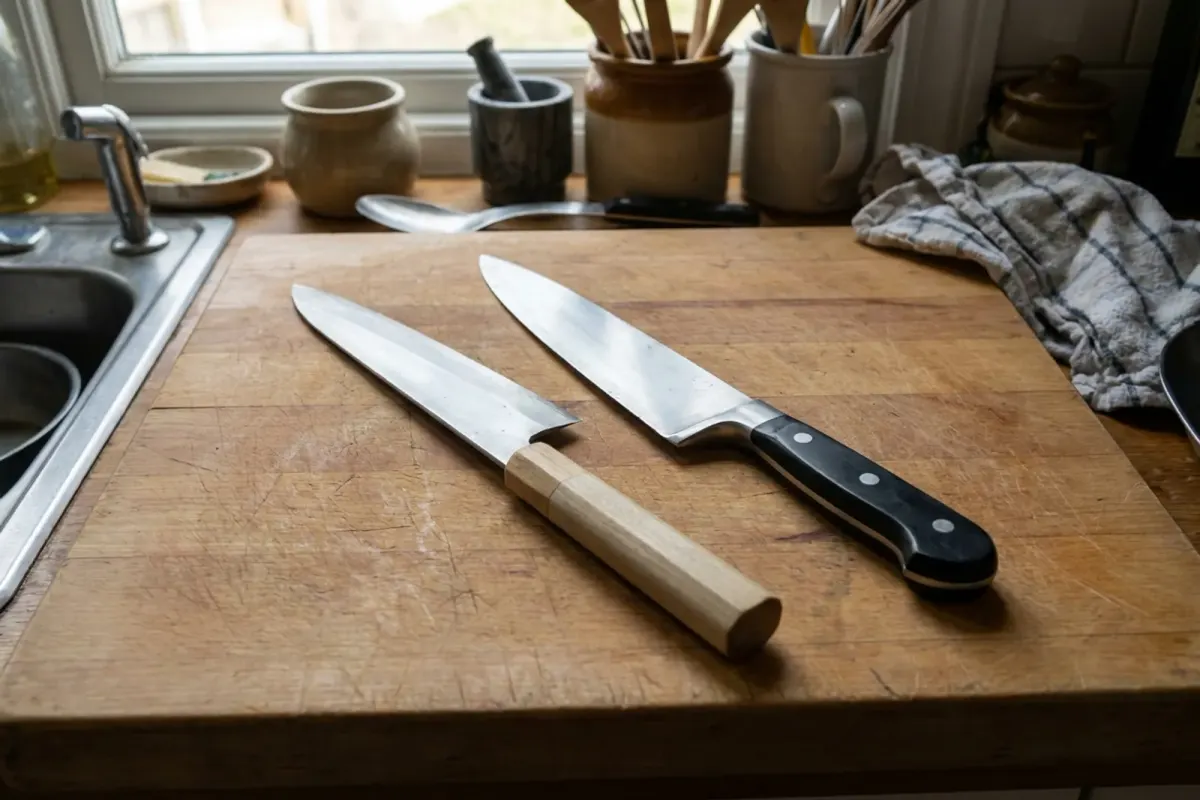
Pick up a classic German chef's knife and then a Japanese one and you'll notice it straight away. The German knife is heavier, with a thick spine and a solid feel. The Japanese knife is lighter and thinner, and it seems to fall through a tomato on its own. Neither is "better". They were designed for different ways of cooking.
The steel: hard versus tough
Knife steel involves a trade-off between hardness and toughness.
- Japanese knives usually use harder steel. Harder steel can be ground to a finer edge and holds it for longer. The downside is that it's more brittle: it can chip if you twist it in a squash or hit a bone.
- German knives usually use slightly softer, tougher steel. The edge dulls a little faster, but it bends rather than chips, and a few strokes on a honing steel bring it back.
That's why a German knife shrugs off rough treatment, while a Japanese knife rewards a gentler hand.
The edge angle
The sharpness you feel is largely about the angle the edge is ground to.
- Japanese knives are traditionally sharpened to a narrower angle, often somewhere around 10 to 15 degrees per side. A narrower edge slices with less effort.
- Traditional German knives were sharpened to a wider angle, around 20 degrees per side, which is sturdier. Many modern German knives have moved closer to 15 degrees, so the gap is smaller than it used to be.
Some traditional Japanese knives are sharpened on one side only, which makes them extremely sharp but tricky for home cooks. Most Japanese-style chef's knives sold today are sharpened on both sides.
Shape and cutting style
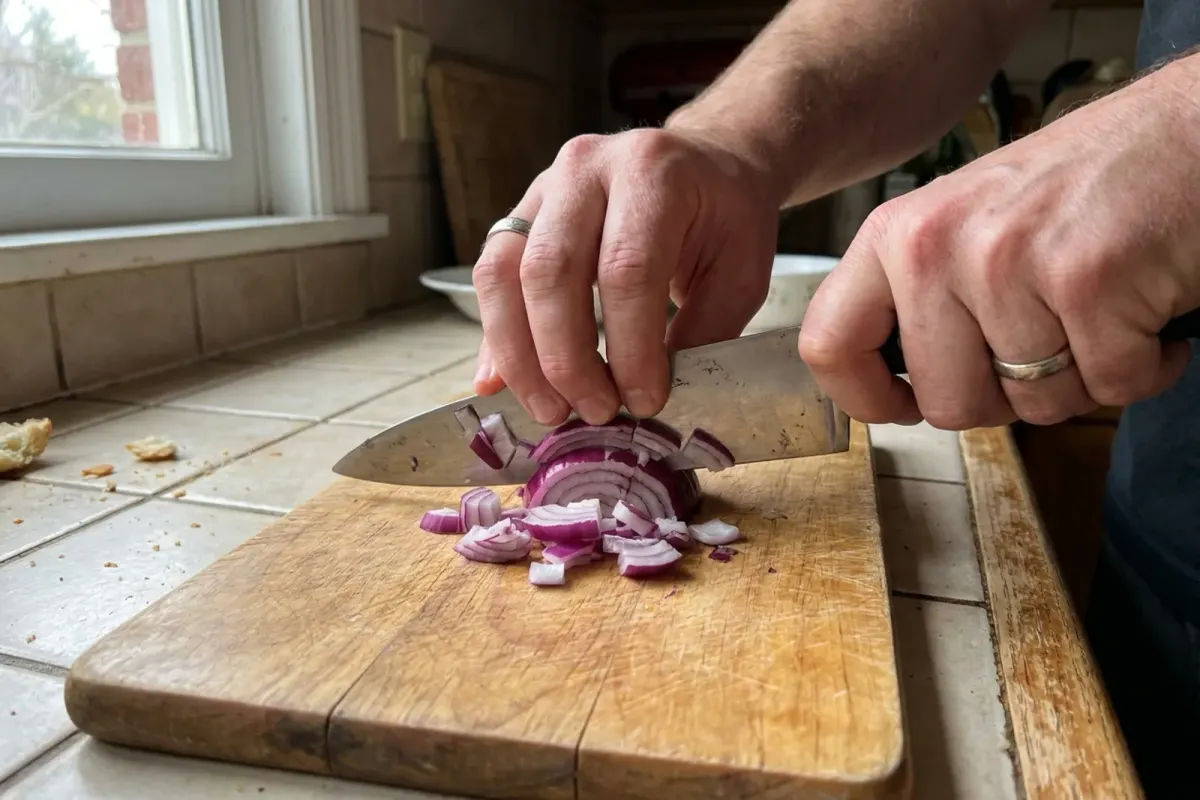
German chef's knives have a curved belly, made for the rocking cut: the tip stays on the board while you rock the blade up and down through herbs or onions. Many have a thick bolster where the blade meets the handle, which adds weight and protects your fingers.
Japanese knives such as the santoku or gyuto tend to have a flatter edge, made for a push or pull cut: the whole blade moves forward or back through the food. They're often lighter, and some have a traditional wooden handle.
Which one should you choose?
Go German if: you want one tough knife for everything, you like the rocking cut, you prefer a heavier feel, or you don't want to worry about chips.
Go Japanese if: you love fine, precise slicing, you like a light knife, and you're happy to hand-wash it straight away and keep it off bones and frozen food.
Care differs a little too
Both should be washed by hand and dried straight away. German knives respond well to regular honing on a steel. Harder Japanese blades are often better maintained on a whetstone or a ceramic rod, because a grooved steel can damage a very hard edge. Whichever you choose, use a wooden or plastic board, never glass or stone.
The best knife is the one that feels right in your hand. If you can, hold both before you buy.
Spotted a mistake? Tell us and we’ll fix it.